
The first planning question is where people will see the piece. A sideline banner viewed from a few feet away can carry finer lettering than a flag waving above a crowd. This is visual hierarchy, the arrangement of elements so the eye notices the most important information first. A large team mark, short name, and clear color contrast usually read faster than several lines of small text. Contrast means the visible difference between neighboring colors or between light and dark areas. If those differences are weak, the design may blur under gym lighting or become difficult to read from the upper seats.
Consider a hypothetical school that places narrow banners along a fence and fills them with a detailed mascot illustration and a long slogan. Up close, the artwork looks lively. During the match, spectators block the lower section, and the slogan vanishes while the illustration becomes an indistinct patch of color. Making everything larger would not solve the problem. The organizers instead simplify the message, give the mascot more breathing room, and repeat the team color at the edges as a visual frame. Negative space, the unused area around design elements, helps the important parts remain legible when fabric shifts.
Construction affects the design as much as color and lettering. A pole sleeve is a sewn tunnel along a flag edge that lets a rod support the fabric without clips crossing the artwork. Grommets are reinforced eyelets that provide attachment points for rope, hooks, or ties. These details suit different situations. A flag carried through an entrance may need to move freely, while a banner on a wall may need a flatter presentation. Before finalizing artwork, describe the location, mounting method, handling, and likely exposure to air movement. That conversation connects the printed layout with the hardware that will hold it.
Here is another hypothetical mistake: a tournament approves a polished welcome banner, but the main message sits too close to the edge. After installation, the hem and fasteners cover part of the lettering. The team had reviewed the artwork while treating finishing details as an afterthought. A better workflow reserves a safe area, which is a margin protecting important content from seams, trimming, sleeves, and holes. Reviewing the full production view, including finished dimensions and attachment points, can reveal problems that a flat digital preview hides. The Cheer Flags and Banners collection offers a useful starting point for that planning discussion.
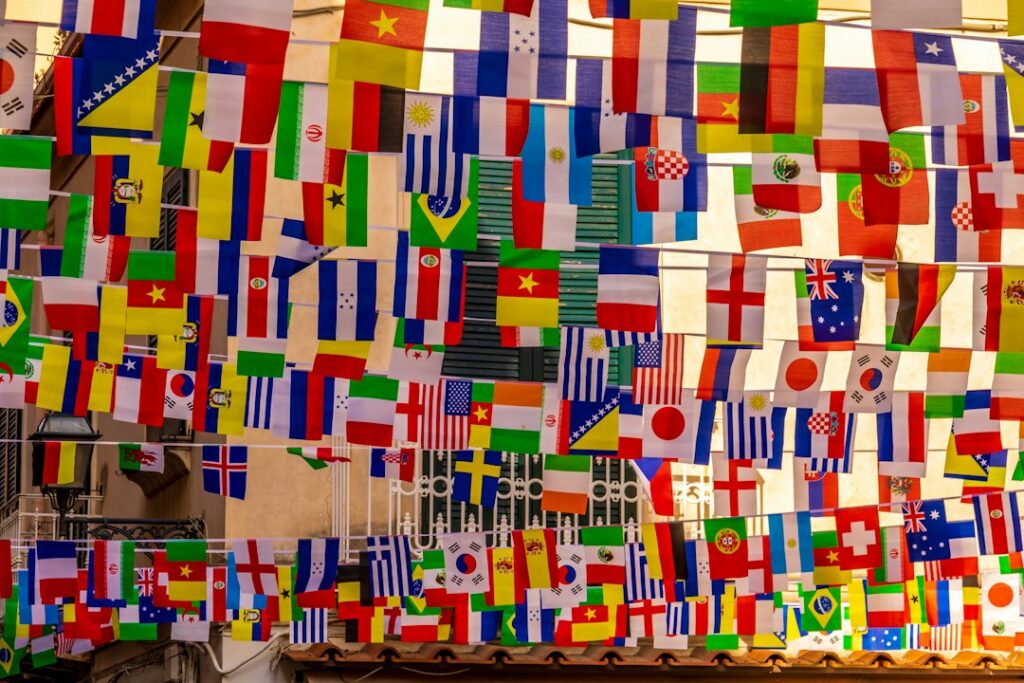
Custom work is most effective when each piece responds to its setting instead of forcing one template everywhere. A tall flag might mark the entrance and build anticipation as guests arrive, while a wide banner can identify a team section or frame a photo area. Several pieces do not need to be identical. Repeating a logo, color pair, or type style creates a recognizable thread, while changing scale and orientation gives each item a distinct job. A designer weighing cost, visibility, and reuse might favor a simpler central mark over an elaborate illustration, especially when the same display will serve different venues.
Before approving a design, walk through the event as a spectator would. Check viewing distance, lighting, mounting direction, foot traffic, and whether the message still makes sense when fabric bends. Request a layout showing finished dimensions, folds, hems, sleeves, and holes, then inspect text at the smallest expected viewing size. If a flag will be handled often, confirm how it will be carried and stored between events. Looking at coordinated team displays can help connect individual pieces to the wider atmosphere. The strongest result is not the busiest one, but the display fans recognize quickly and remember clearly.