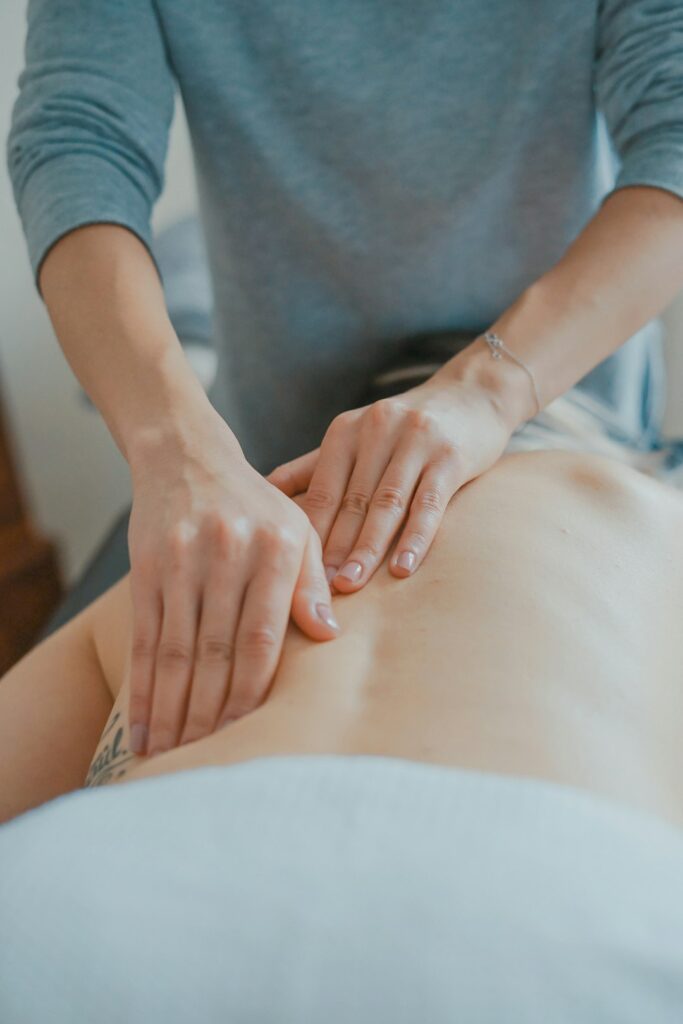

Remedial massage uses hands on techniques to address sensitive or restricted soft tissue and make movement more comfortable. Soft tissue includes muscles, tendons and the connective layers around body structures. Depending on the assessment, treatment might involve sustained pressure, compression, kneading, gentle stretching or movement during contact. Pressure should have a clear purpose and should be adjusted to your response. Mild tenderness can occur, but severe pain is not a useful measure of treatment quality. Tell the practitioner if symptoms become sharp, spread beyond the treated area or remain noticeably worse after the session. That feedback helps prevent an avoidable flare up.
A practitioner may mention trigger points or myofascial restriction during an appointment. A trigger point is a particularly sensitive area within muscle that may hurt locally or refer discomfort nearby. Myofascial restriction describes reduced movement or sensitivity involving muscle and fascia, the thin connective tissue surrounding and separating many structures. These terms describe findings rather than proving a single cause. A careful assessment should connect them with your history, movement testing and daily demands. It is also reasonable to ask what a term means, what the treatment is intended to change and how progress will be checked at the next visit.
An office worker who spends hours leaning towards a laptop may feel a locked upper back and sore neck by late afternoon. The contributing factors could include limited rotation through the middle spine, a forward head position, few movement breaks and low tolerance for sustained sitting. Thoracic rotation means turning through the section of the spine between the neck and lower back. Massage may temporarily reduce protective muscle tension and make rotation easier. A practitioner might then suggest placing the screen at a more comfortable height, checking the workstation setup and standing for brief movement breaks before stiffness builds. Small changes often reduce the need to repeatedly treat the same irritation.
A runner can develop calf tightness after adding hills, distance or faster intervals too quickly. Calf tenderness does not identify the whole problem by itself. The assessment may consider recent training notes, ankle movement, footwear, recovery between sessions and any change in running technique. Range of motion refers to how far a joint moves comfortably and safely. Massage may reduce sensitivity and make walking or light exercise feel easier, but the runner still needs a measured return to loading. Load is the physical demand placed on tissue. Increasing hills or speed in manageable stages gives the calf time to adapt and makes it easier to tell whether training, rather than soreness alone, is driving the symptoms.
Hands on care is often more useful when paired with active rehabilitation. Proprioception is the body’s awareness of joint position and movement without needing to look. Balance drills, controlled weight shifts and coordination exercises can challenge that awareness, while strengthening improves the capacity needed for work, sport and daily tasks. People comparing treatment options through remedial massage redcliffe may find that massage and exercise serve different purposes. Massage can settle symptoms or improve short term movement. Exercise helps a person practise control under gradually increasing demands, which is important if the same activity has repeatedly brought the problem back.
Clinical Pilates may suit someone who can move more comfortably after massage but still lacks strength, balance or confidence. A session could begin with breathing, gentle spinal movement and basic control before progressing to exercises for the hips, trunk or shoulders. Someone returning from an ankle injury might start with supported balance and then work towards single leg control as stability improves. The level should match current ability rather than follow a fixed routine. Access to clinical pilates for movement control may be relevant when the goal is to rebuild everyday function, not simply reduce tenderness for a few hours.
A useful appointment should leave you with a clear next step. That might include monitoring whether turning, walking or training feels easier, modifying one workout, practising a mobility exercise or arranging a review if progress stops. Keeping a brief note of what changed after treatment can help both you and the practitioner avoid guessing at the next session. Seek medical assessment for severe unexplained pain, major swelling, fever, significant weakness, new numbness or symptoms after a serious injury. For ordinary muscle tension and movement restriction, remedial massage can form one part of a sensible Redcliffe care plan that also addresses mobility, strength, habits and a gradual return to normal activity.